
Part 1. Unwavering attention
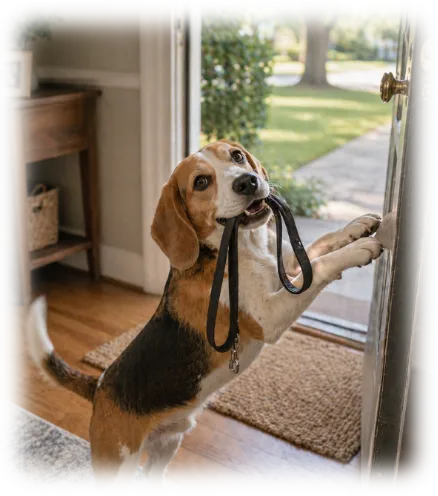
The moment I change into a slightly formal shirt, Simba zooms to the door, buzzing with anticipation for a car ride. But if I don’t mirror his enthusiasm, everything shifts. His tail drops. He turns away and slumps on the floor, deflated.
All of this happens without me saying a single word.
Dogs are constantly reading us. Not in some mystical, mind-reading sense. But in a way that is even more remarkable. Their sensitivity has been shaped over tens of thousands of years of living alongside humans.
At first, it was about survival. Wolves that could tell which humans were safe, which gestures signaled food, and which tones warned of danger were more likely to survive. Over generations, that attentiveness became instinct. Curiosity turned into connection. And gradually, the two species learned to understand each other.
What we see in our living rooms today is the result of that long partnership.
Dogs even process language in sophisticated ways. Areas in their left brain handle words while areas in their right brain interpret the tone. They are especially attuned to prosody—the rhythm, tone, and emotional texture of speech. A simple “good boy,” spoken warmly or harshly, carries different meanings for them.
And it goes far beyond sound. I know Simba is constantly picking up my micro-signals: my posture, breathing, the tension in my shoulders, and even subtle shifts in my scent. I am an open book for him.
The force behind this extraordinary ability is attention—complete, present, and free of judgment. It is this quiet, unwavering, non-judgmental presence, tuned to the most important person in their world, that makes them our closest companions.
Reference: Andics A, Gábor A, Gácsi M, Faragó T, Szabó D, Miklósi Á. Neural mechanisms for lexical processing in dogs. Science. 2016 Sep 2;353(6303):1030-1032. doi: 10.1126/science.aaf3777. Epub 2016 Aug 30. Erratum in: Science. 2017 Apr 7;356(6333):eaan3276. doi: 10.1126/science.aan3276. PMID: 27576923.
Albuquerque N, Resende B. Dogs functionally respond to and use emotional information from human expressions. Evol Hum Sci. 2022 Dec 6;5:e2. doi: 10.1017/ehs.2022.57. PMID: 37587944; PMCID: PMC10426098.

Part 2. Clear priorities
Dogs have no conflict about who or what matters most. You are the center of their world. There is no divided loyalty, no internal debate about priorities.
Most days, I feel flattered by Simba’s attention. Some days, it feels like a small invasion of privacy—like when he follows me all the way to the bathroom door.
But it makes me wonder: what would change in my life if I paid attention the way Simba does? If I truly listened and felt what others are expressing instead of quietly waiting for my turn to speak? I have little doubt that my relationships with the people who matter most would deepen.
One of the most important lessons Simba has taught me is that communication isn’t primarily about words. Both of us are always speaking, silently. He with his tail, ears, eyes, and body. I with my posture, facial expressions, and breathing. And when I do speak, how I say something often matters just as much as what I say.
Reference: Müller, C. A., Schmitt, K., Barber, A. L. A., & Huber, L. (2015). “Dogs Can Discriminate Emotional Expressions of Human Faces.” Current Biology, 25(5), 601-605. DOI: 10.1016/j.cub.2014.12.055.
Call J, Bräuer J, Kaminski J, Tomasello M. Domestic dogs (Canis familiaris) are sensitive to the attentional state of humans. J Comp Psychol. 2003 Sep;117(3):257-63. doi: 10.1037/0735-7036.117.3.257. PMID: 14498801.
