
Part 1: The friendliness gene
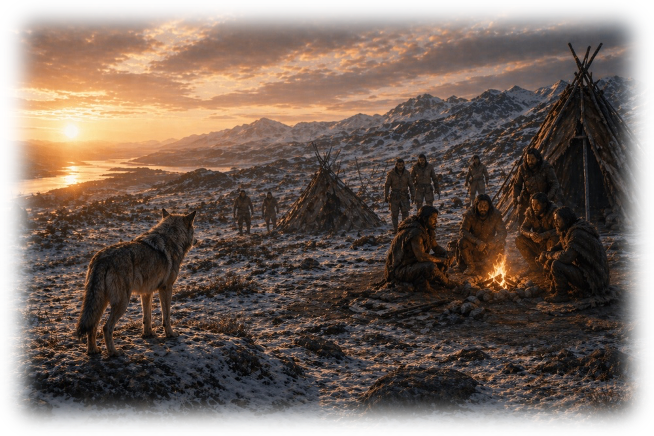
At the edge of a forest in the late Pleistocene era, long before cities or even language as we know it, lived an ancestor of the modern wolves. She was not so different from the others, but not quite the same either. She was curious.
While her pack kept a wary distance from the strange, fire-bearing bipedal, she lingered at the margins of their world. She did not rush in recklessly, but she did not retreat as quickly as the others. Where her pack saw danger, she sensed possibility. Like, scraps of food, the promise of warmth, the faint outline of a relationship neither species yet understood.
That small difference in behavior was rooted in something even smaller: subtle shifts in how her genes were regulated.
Genetically, she was almost identical to every other wolf. There were no dramatic mutations or sudden appearance of new genes. Instead, the change was quieter. Certain genes, especially those involved in fear, stress, and social behavior, were expressed just a little differently. It was the same script, played with softer lighting and a gentler tone.
Reference: Skoglund P, Ersmark E, Palkopoulou E, Dalén L. Ancient wolf genome reveals an early divergence of domestic dog ancestors and admixture into high-latitude breeds. Curr Biol. 2015 Jun 1;25(11):1515-9. doi: 10.1016/j.cub.2015.04.019. Epub 2015 May 21. PMID: 26004765.
Bergström A, Frantz L, Schmidt R, Ersmark E, et al. Origins and genetic legacy of prehistoric dogs. Science. 2020 Oct 30;370(6516):557-564. doi: 10.1126/science.aba9572. Epub 2020 Oct 29. PMID: 33122379; PMCID: PMC7116352.

A genetic ripple:
Deep within her genome, on chromosome 6, lay a pair of powerful genes: GTF2I and GTF2IRD1. These were master regulators guiding entire networks in the brain.
They shaped how an animal responded to fear, formed bonds, and paid attention to others. In this wolf, tiny structural variations like small insertions and slight rearrangements in the DNA, altered how these genes functioned. Not dramatically, but enough to soften fear, spark curiosity, and allow proximity where others would flee. And that was all evolution needed.
She stayed a little longer near the fires, ate what others would not risk approaching, and learned that humans, though dangerous, were also predictable. And in the harsh arithmetic of survival, she began to do better than the rest.
Over generations, calmer, more observant, and less reactive wolves like her, thrived in this new ecological niche. Friendliness, once an anomaly, became an advantage. And eventually, humans began to notice.
These wolves hung out at the outskirts of the tribe. They were perfect at sounding alarm of an approaching predator. The relationship was no longer one-sided.
But something was still unfinished. She was still, unmistakably, a wolf. Her ears stood sharp and alert, not soft and folded. Her powerful jaw was built for tearing, not trust. Her presence, though familiar, was still edged with danger. The bond had begun. But the transformation was not yet complete.
Reference: vonHoldt, B. M., Shuldiner, E., Janowitz Koch, I., Kartzinel, R. A., Stec, A., Cornwell, B. K., … & Udell, M. A. (2017). Structural variants in genes associated with human Williams-Beuren syndrome underlie stereotypical hypersociability in domestic dogs. Science Advances, 3(7), e1700398.
Part 2: The cute transformation
As these subtle behavioral traits accumulated across generations, something remarkable began to unfold. Evolution started to reshape the appearance.
Deep within the developing embryo, a group of cells known as neural crest cells began to change. These cells are powerful architects. They influence everything from fear and stress responses to skin pigmentation, skull shape, and even the structure of ears.
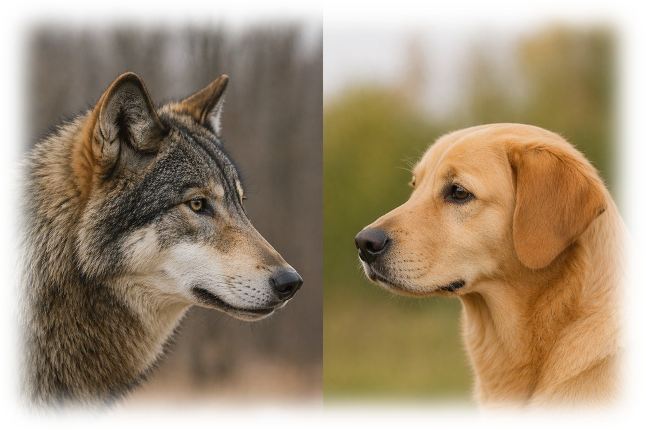
Tiny shifts in how the genes controlling these cells were regulated set off a cascade of changes.
And slowly, almost imperceptibly at first, the wolf began to look different.
Ears softened and folded.
Snouts shortened.
Teeth grew smaller.
Coats became more varied—patches, spots, colors never seen in the wild.
And alongside these physical changes came something even more profound: an increasing ease with others. A growing tendency toward connection and trust.
Scientists now call this suite of changes “domestication syndrome.”
Reference: Wilkins, A. S., Wrangham, R. W., & Fitch, W. T. (2014). The “domestication syndrome” in mammals: A unified explanation based on neural crest cell behavior and genetics. Genetics, 197(3), 795-808. DOI: 10.1534/genetics.114.165423.
Part 3: Eating together
So much more lay in store as this casual collaboration was not becoming an enduring partnership. The less fearful wolves became increasingly useful. They could smell what humans couldn’t, hear frequencies unavailable to us, and saw the slightest movement in the grass we wouldn’t notice. They started guarding early settlements, helped herd animals, and became partners in the hunt. And sometimes, they simply stayed close, giving comfort to humans in a way no wild creature had done before.
Even their diets started to converge. As humans moved into farming and began relying on grains and starchy plants, these early dogs adapted alongside them. They evolved extra copies of a gene called AMY2B, allowing them to digest starch far more efficiently than their wolf ancestors ever could.
They were not only living near humans. They had started eating from the same plate. Well almost.
Reference: Reiter T, Jagoda E, Capellini TD (2016) Dietary Variation and Evolution of Gene Copy Number among Dog Breeds. PLoS ONE 11(2): e0148899. https://doi.org/10.1371/journal.pone.0148899
Part 4: Designer dogs
And then humans did what evolution had only just begun. They took control. No longer passive observers, people began to shape these animals deliberately by breeding them for specific traits.

Some were bred for stamina and the ability to follow complex commands to manage livestock (e.g., German Shepherds and Border Collies).
Others were selected for their drive to locate game, keen sense of smell, and high energy (e.g., Beagles and Labradors).
Still others became the guardians and protectors by evolving a strong sense of territoriality and ability to stay alert and vigilant against threats (e.g. Rottweilers and Bullmastiffs).
More niche traits emerged like speed for racing (Greyhounds) and swimming for water rescue (Portuguese Water Dogs). And of course, many for fashion and comfort, by just hanging out or sitting in our laps (e.g., Maltese, Pugs, Chihuahua, Toy Poodle, Yorkshire Terrier).
Our journey together has just begun. It will continue evolving in interesting ways as we increasingly need dogs for helping us feel happier and connected. We might also go together in space. Laika, a stray mongrel from the streets of Moscow, preceded humans into space aboard Sputnik 2. Perhaps, dogs might precede us to Mars.
All of this started through a handful of changes in how genes are regulated. A cautious apex predator became something entirely new. A species that could meet a human gaze, sense intention, and choose connection over caution.
Reference: Dutrow, E. V., Serpell, J. A., & Ostrander, E. A. (2022). Domestic dog lineages reveal genetic drivers of behavioral diversification. Cell, 185(25), 4737-4755.e18. doi:10.1016/j.cell.2022.11.003
