
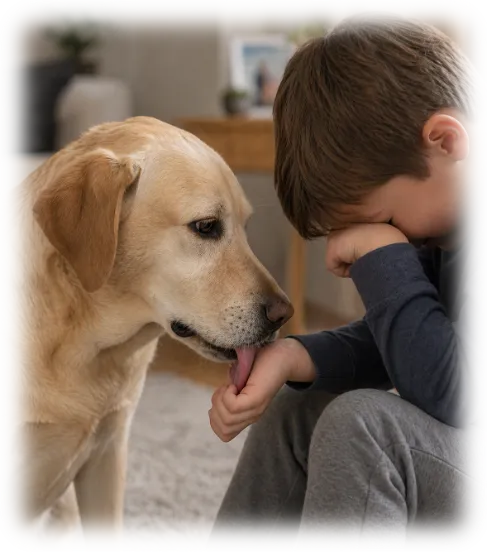
Part 1. You Cry, I Cry
Picture this: you’re sitting on the couch, staring into the void after a difficult day. Your dog slowly walks over. She isn’t looking for a treat or play. She sits with a quiet plop real close to you. Next, she gently rests her head on your knee. She looks at you like, “I don’t know what went wrong for you today, but I’m here.” It feels intentional, thoughtful, and human.
Every time I have asked a dog family whether their dog understands their feelings, they haven’t just said yes. They have also shared, in impressive details, the amazing ways their dog responds to their feelings.
Scientists decided to test this by having people sit with their dogs and either hum or pretend to cry. Consistently, the dogs chose to come to the “crying” person, even if the crying person was a stranger. And dogs not only came, they also shared a caring gesture such as giving their paw or licking somewhere(therapy comes in many forms).
This is emotional empathy—one being catching another’s feelings. I’m sure you do it all the time. You yawn seeing someone else yawn. You might have gotten stressed seeing your child, partner, or best friend get stressed. Neuroscientists believe that we evoke other people’s feelings in our brain to experience what they are feeling. The closer the relationship, the stronger the effect. Dogs are doing the same.
So, is your dog deeply understanding your feelings or just superficially reacting? It might be a little bit of both. But either way, they show up. And that’s amazing for a being who has a brain no bigger than a chicken’s egg.
Reference: Custance D, Mayer J. Empathic-like responding by domestic dogs (Canis familiaris) to distress in humans: an exploratory study. Anim Cogn. 2012 Sep;15(5):851-9. doi: 10.1007/s10071-012-0510-1. Epub 2012 May 29. PMID: 22644113.
Siniscalchi M, d’Ingeo S, Fornelli S, Quaranta A. Lateralized behavior and cardiac activity of dogs in response to human emotional vocalizations. Sci Rep. 2018 Jan 8;8(1):77. doi: 10.1038/s41598-017-18417-4. PMID: 29311574; PMCID: PMC5758824.
Part 2. Biologically Attuned
Our brain considers our dogs no different than our infants. When dogs interact with family, through eye contact or petting, both dogs and their family members experience an increase in oxytocin. This is the same hormone involved in human bonding, including between parents and children. The oxytocin bump and the bond don’t need much thinking since they are hosted by the subcortical brain. Dogs and humans have a very similar subcortical brain.

Where humans differ a lot is in having a complex higher cortical brain. It empowers us to think, sometimes a bit too much. Dogs’ lives are relatively simple. They don’t experience empathy in the same layered, reflective way as humans do. We tell ourselves, “You must be upset because your project got cancelled at work today.” Dogs on the other hand are tuned to your posture, facial expressions, and voice. In fact, they can even tell if you “smell” of stress.
So, when Simba looks at me with soft eyes, the depth and intention I read likely goes beyond what’s happening for him. But even if part of the meaning I assign is just mine, the bond itself is real. The responsiveness and the comfort I get is also real. I know this is one bond I can trust. He comes from a lineage of ancestors who have proven their love and loyalty over thousands of years.
I must confess that sometimes I don’t need another person to dwell on my story. I just need them to feel that something matters and sit with me without asking any questions. That’s what Simba provides. He meets me emotionally in a way that feels deeper than empathy. It helps me to know that my experience is grounded in real biology and connection.
Reference: Nagasawa M, Mitsui S, En S, Ohtani N, Ohta M, Sakuma Y, Onaka T, Mogi K, Kikusui T. Social evolution. Oxytocin-gaze positive loop and the coevolution of human-dog bonds. Science. 2015 Apr 17;348(6232):333-6. doi: 10.1126/science.1261022. Epub 2015 Apr 16. PMID: 25883356.
Stoeckel LE, Palley LS, Gollub RL, Niemi SM, Evins AE. Patterns of brain activation when mothers view their own child and dog: an fMRI study. PLoS One. 2014 Oct 3;9(10):e107205. doi: 10.1371/journal.pone.0107205. PMID: 25279788; PMCID: PMC4184794.
Turcsán B, Ujfalussy DJ, Kerepesi A, Miklósi Á, Kubinyi E. Similarities and differences between dog-human and human-human relationships. Sci Rep. 2025 Apr 22;15(1):11871. doi: 10.1038/s41598-025-95515-8. PMID: 40258899; PMCID: PMC12012045.
