
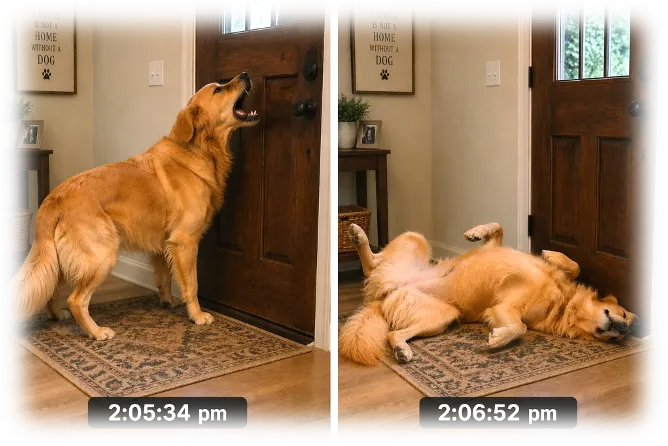
The door creaks. And suddenly your dog transforms into a full-blown security system. Barking. Sprinting. Sliding across hardwood floors. The threat is the mail carrier or a bunny that moved from one bush to another in the yard.
And then, a minute later, the same dog is sprawled on the floor. Belly up. Breathing softly. At peace with the universe.
How do dogs do that?
One of the main reasons is they lack an inner voice saying, “Wow, that bark earlier, was a bit shrill.” Without that voice constantly hammering them, they do not linger on their previous experience too much. They move on.
Their moving on is easier because the past is quickly replaced by what’s in front of them. A dog’s life is dominated by their sensory experience, not their thoughts. They are mindfully taking it all in. Except perhaps while eating. Simba literally swallows his food in less than a minute, as if I’m right behind trying to get to his kibble. I have miserably failed teaching him mindful eating!
I’d love to embody the simplicity of Simba, but I am not there yet. Far from it. If he misses a catch, he doesn’t go, “Classic me. I’m just not a ball-catching kind of dog.” It’s just: miss, pause, next throw please.
It’s a little unfair how good dogs are at this without even trying. But also, a little instructive. Somewhere between barking at imaginary threats and immediately forgetting them, dogs figured out something we’re still working on: How to let a moment be just a moment. And then let it go.
Reference: Hare E, Kelsey KM, Niedermeyer GM, Otto CM, (2020). Long-Term Behavioral Resilience in Search-and-Rescue Dogs Responding to the September 11, 2001 Terrorist Attacks, Applied Animal Behaviour Science, doi: https://doi.org/10.1016/j.applanim.2020.105173
Tiira K. Resilience In Dogs? Lessons From Other Species. Vet Med (Auckl). 2019 Nov 15;10:159-168. doi: 10.2147/VMRR.S189566. PMID: 31815099; PMCID: PMC6863117.
